
Albanese called it theft. He was talking about books and music. Ask the same question about your ledger.
On 15 July the Prime Minister made "what did you train on" a national question. He was answering it for novelists. Nobody in Canberra is answering it for you.
The short answer. No, VibeCFO does not train AI on your accounting data. EVA runs on frontier models that do not train on customer inputs, and under our Xero partnership we are contractually prohibited from training on client data. She does not learn from your ledger. She writes a SQL query against your own dedicated database and returns the figure that is already there.
Anthony Albanese stood up at the University of Sydney and put artificial intelligence in the same bracket as civil aviation in the 1920s and genetics in the 1990s. A new Office of AI now sits inside the Department of the Prime Minister and Cabinet, effective immediately. It will coordinate a set of mandatory Australian AI Standards, which the government says it will legislate early next year. Data centres get real obligations: underwrite your own power, do not push up household bills, keep water use down.
Significant. Also, if you run a business or a firm, strangely quiet.
What did Albanese actually say about AI training data?
The sharpest language in the speech was about training data.
The government has again ruled out a text and data mining exception. That is the carve-out that would let AI companies scrape Australian books, music, art and journalism to build models without permission or payment. Albanese's framing was blunt. Unless the creator keeps control over how the work is used and what it is worth, anything less is theft.
Be precise about the scope, because it matters.
He was talking about creative work. Novelists, musicians, artists, journalists. He was not talking about your ledger, your client records or your customer list. Those sit under privacy law and existing regulators, and they were not in the speech. There are no fines here either. There is no legislation yet, so there is nothing yet to be fined under.
The principle does not stop at the arts
Strip the sentence back and here is what is underneath it.
Nobody should be feeding your work into a model without you controlling whether that happens and what it is worth.
Read that again with a general ledger in place of a manuscript. It reads identically. The law treats the two differently. Your gut does not.
And once you ask that question about business data rather than creative work, the answers in the market get uncomfortable.
From 17 August 2026, Atlassian begins using customer content from Jira and Confluence to train its AI products. Whether you can opt out at all depends on which subscription tier you are on. It reverses a position the company's own documentation still states, that customer data belongs to the customer. Figma has spent the past year defending a claim that it trained on millions of customer design files after years of assuring users it would not. Figma denies it and the matter has gone to arbitration.
Notice the shape of both. Nothing was stolen from outside. It was repurposed from inside, quietly, by default, by a vendor who had already been trusted with it.
That is the version of the theft question that lands on your desk. Not whether an AI lab can train on Tim Winton. Whether your finance software is doing something with your numbers that you did not agree to.
Where does your accounting data actually go?
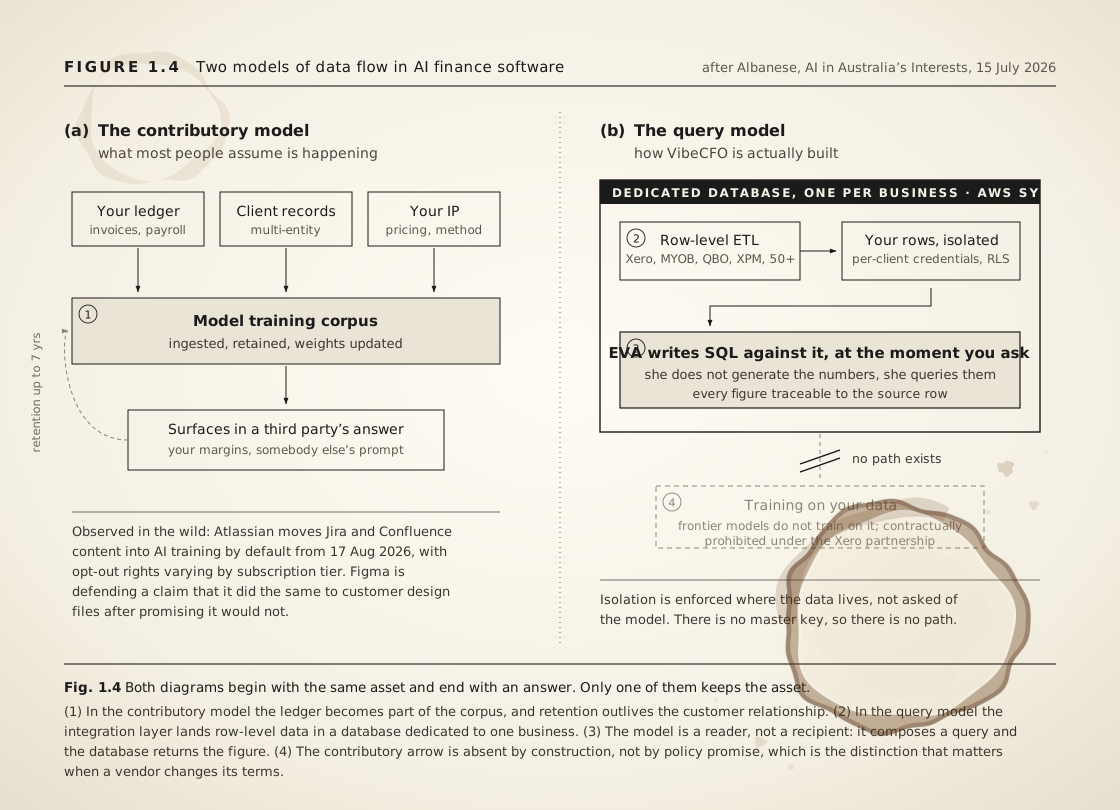
Panel (a) is the fear. Your ledger, your client records and your pricing go into a corpus, get retained, and turn up later in somebody else's answer.
Panel (b) is how VibeCFO is built. The difference is not a promise. It is an absence. There is no arrow.
EVA does not train on your data. She queries it.
Those are different things, and the difference is the whole architecture.
Every business gets its own database. Not a shared table with your name in a column. A dedicated database, hosted on AWS in Sydney for every customer, wherever they are located. Your data is stored in a separate database from every other business, not in shared tables.
Every business has its own credentials. Each business has its own database credentials, which are the only credentials EVA holds for your data, and inside a firm row-level security means each client organisation only sees its own data. Isolation is designed in where the data lives, not asked of the model and hoped for, and tenant isolation is part of the scope of our security testing programme.
She writes SQL, she does not invent numbers. Ask EVA a question and she composes a query against your database. The figure comes back from your rows, the same rows your accountant works from. Pin a visual and it becomes a stored SQL command, no longer touched by AI at all. This is why hallucinated numbers are not a category of risk here. She is not generating the number. She is fetching it.
Nothing trains on it. EVA runs on Amazon Bedrock under our AWS agreement: neither model developer receives your data, and no model is trained on it. Under the Xero partnership we are contractually prohibited from training on client data. Two independent reasons, one outcome. The same holds when an outside agent asks: The VibeCFO MCP queries your data in place, per call, and it is read-only.
So when EVA is sharp, in depth and accurate the way a good CFO is, know where that comes from. It comes from purpose-built ETL that pulls row-level data. Xero invoice lines. Timesheets row by row. Stock on hand. Across financial and operational systems, because operational data is what explains financial performance. Every figure traceable to the source row.
Not from having eaten anybody's books. A model that has swallowed a million ledgers still cannot tell you why your gross margin moved last month. One that can read all of yours, properly, can.
None of that is a compliance posture we adopted last Wednesday because the Prime Minister gave a speech. It is how the thing has been built since 2018. The full detail is on our security page.
What the speech left out
Read the announcement closely and one group is almost absent. The ordinary Australian business owner.
No productivity targets for SMEs. No adoption incentives. Nothing practical for the cafe, the tradie, the accounting firm or the manufacturer trying to work out what AI does for their numbers on a Tuesday afternoon.
That is a description of the gap, not a complaint. Governments set frameworks. They do not run your reporting, chase your aged debtors, or tell you whether this month's margins can carry a new hire.
Questions worth asking your vendor
Is my accounting data used to train AI models?
No. The frontier models EVA runs on do not train on customer data, and under the VibeCFO Xero partnership we are contractually prohibited from training on client data. EVA does not learn from your ledger. She writes a SQL query against your own dedicated database and returns the figure that is already there.
Where does VibeCFO store my financial data?
On AWS in Sydney, Australia, for every customer, wherever they are located, in a database dedicated to your business alone. Data is encrypted in transit with TLS 1.3; uploaded documents and backups are encrypted at rest, with encryption at rest of the production database scheduled for completion by 2026-10-16. EVA runs on Amazon Bedrock under our AWS agreement. The model that orchestrates each request is supplied by Anthropic and runs in AWS Australia. The model that does the heavy lifting is supplied by OpenAI and runs on AWS infrastructure, which may be outside Australia. Neither model developer receives your data through Amazon Bedrock, and no model is trained on it. We also use the Anthropic API directly for web search, for document exports and as a backup, and that processing takes place in the United States. How we protect your data.
Can one client's data reach another client's answer?
Every business has its own database, and access is controlled at two layers: the application resolves which database a request may reach from the signed-in user's own firm membership, and each business has its own database credentials, which are the only credentials EVA holds for your data. Inside a firm, row-level security means each client organisation only sees its own data. Tenant isolation is part of the scope of our security testing programme.
Can EVA hallucinate financial figures?
EVA does not generate numbers. She writes SQL against your database and returns what is in your rows, the same rows your accountant works from. Pin a visual and it becomes a stored SQL command that AI no longer touches. If a figure looks wrong, it is the ETL refresh, not a hallucination. See how EVA works.
What did Albanese announce about AI and copyright on 15 July 2026?
The Australian Government established an Office of AI within the Department of the Prime Minister and Cabinet and ruled out a text and data mining exception, meaning AI companies get no copyright carve-out to train on Australian books, music, art or journalism. The announcement covered creative work, not business or accounting data, and introduced no fines.
What happens when a vendor changes its terms of service?
That is the real question, and it is why architecture beats policy. A promise can be updated on a Tuesday. A missing arrow cannot. VibeCFO has no training path to switch on, because the contributory arrow is absent by construction rather than by policy promise.
Now you know
Connected data is becoming normal. Secure, trusted CFO action is not.
The Prime Minister asked what the country's creative work is being trained on. Ask the smaller, sharper version about your own numbers, and ask it of every vendor holding them. Ask where the database sits. Ask who holds the credentials. Ask whether the answer is generated or queried. Ask what happens on the day the terms of service change.
Then check the diagram again and count the arrows.
Out of the box. Governed and secure. No dashboard to decode, and no AI to train.
VibeCFO is an Australian agentic AI CFO for small businesses and accounting firms, protecting accounting-firm data since 2018. Meet EVA at vibecfo.ai, or read exactly how your data is handled at vibecfo.ai/security.
See where your numbers actually live
Connect your data, ask EVA a question, and watch every figure trace back to your own dedicated database. No pooled data, no training, no arrow.
Start your 14 daysRelated Articles
AI Security: The Crucial Balance Between Privacy and Protection
Understanding the balance between using AI capabilities effectively while maintaining data privacy and security.
Connecting Data Is Easy. Trusting the Answer Is the Hard Part.
Connecting data is not the same as understanding a business. The real challenge is not access. It is interpretation.